Examples#
Every example is a real recipe. The “Results” column below lists the engines whose results are committed with it; TOPAS results are not committed. Run any of them from a PowderLine checkout, into a folder of your own:
pixi run -e gsasii powderline examples/<name>/input.json --output my_run
Your results are then in my_run/.
Warning
Always pass --output when you run a committed example. Without it, the
results go to the example’s own output/ folder and overwrite the committed
results there.
Examples with a TOPAS or easydiffraction version keep it in a subfolder
(topas/, easydiffraction/). Run an easydiffraction recipe in the
easydiffraction environment. A TOPAS recipe needs TOPAS 6 (tc.exe) on
Windows:
pixi run -e easydiffraction powderline examples/<name>/easydiffraction/input.json --output my_run_ed
pixi run powderline examples/<name>/topas/input.json --topas-version 6 --topas-dir C:/TOPAS6 --output my_run_topas
Validate any of them without an engine. Validation writes nothing:
pixi run powderline examples/<name>/input.json --validate-only.
Each example folder has a DESCRIPTION.md that explains the case and the
results you should get. Its output/ folder holds the committed results.
They are also the regression references, so a change to them is a
deliberate change.
The figures show the committed fit over the fit window: the observed pattern in gray, the calculated pattern in blue and the difference curve in orange, below.
Starting points#
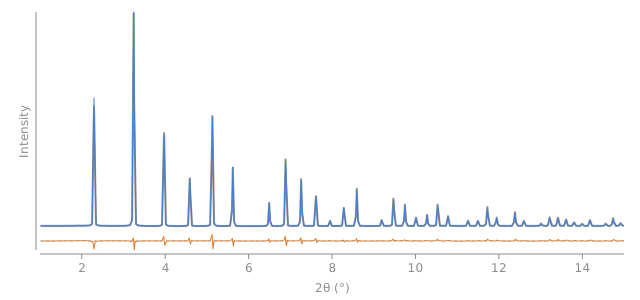
Refine against a NIST SRM 660c pattern to determine the instrument profile. Rwp 6.53 %.
calibration GSAS-II · TOPAS · easydiffraction
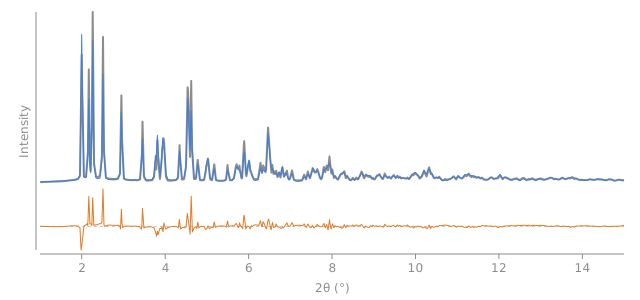
A two-phase battery cathode material. Crystallite size is held and microstrain is refined. Rwp 8.46 %.
multi-phase GSAS-II
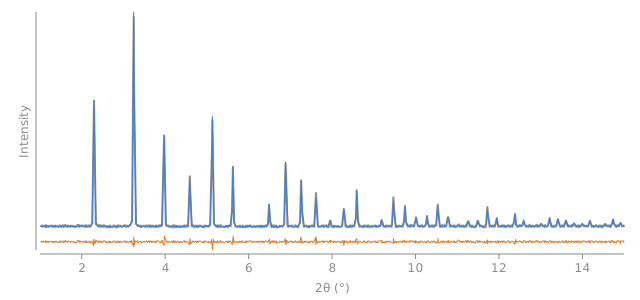
One model refined in sequence against six simulated patterns from 25 to 500 °C, through the output recipe. The figure shows the first step in easydiffraction.
sequential simulated GSAS-II · easydiffraction
By feature#
“Recipes” lists the engines the example has a recipe for. “Results” lists the
engines whose results are committed with it. TOPAS results are not committed
under examples/.
Example |
Shows |
Recipes |
Results |
Data |
|---|---|---|---|---|
Instrument profile from a standard: scale, Chebyshev background and the U–Z profile refined |
GSAS-II, TOPAS, easydiffraction |
GSAS-II, easydiffraction |
measured |
|
Ionic scattering types ( |
GSAS-II, TOPAS, easydiffraction |
GSAS-II, easydiffraction |
measured |
|
March–Dollase preferred orientation: r = 0.6 programmed, 0.5978(14) recovered by GSAS-II |
GSAS-II, TOPAS, easydiffraction |
GSAS-II, easydiffraction |
simulated, known answer |
|
Sequential refinement: each step starts from the previous output recipe |
GSAS-II, easydiffraction |
GSAS-II (series tables), easydiffraction (first step) |
simulated, known answer |
|
Calculating a pattern: every refine flag off, one cycle |
GSAS-II |
GSAS-II |
calculation |
|
Single-peak fitting of 36 peaks, no crystal structure |
GSAS-II, TOPAS |
GSAS-II |
measured |
|
Two phases (cubic and monoclinic), size and strain refined |
GSAS-II, TOPAS, easydiffraction |
GSAS-II, easydiffraction |
measured |
|
Two phases, size held and microstrain refined |
GSAS-II |
GSAS-II |
measured |
|
Anisotropic displacement parameters ( |
GSAS-II |
GSAS-II |
measured |
|
Atom coordinates, occupancies and |
GSAS-II |
GSAS-II |
measured |
|
Calculating a two-phase pattern |
GSAS-II |
GSAS-II |
calculation |
example_DRX_33 (GSAS-II recipe), example_DRX_33_anisoADP,
example_DRX_33_atomrefine, example_LaB6_singlepeakfit and the
easydiffraction recipe of example_LaB6_ionic are teaching examples. See the
next section before you copy them.
Teaching examples#
These examples show what an ill-posed refinement looks like.
These examples are ill-posed on purpose
They ask more of the data than the data can determine. They are kept as they are, so you can see what that looks like and which signals PowderLine gives. Each one names its well-posed variant where one exists. Don’t copy their refinement choices.
In each one the refinement ends on a value the schema refuses. PowderLine
still writes the output recipe, so you can see what the engine produced. The
result says output_recipe_valid: false, and the warning names the value.
KI-15 records the decision to keep them.
Example |
What goes wrong |
What PowderLine reports |
Well-posed alternative |
|---|---|---|---|
|
Size and strain refined together: the Li4MgWO6 crystallite size runs to −1355.6 µm |
|
|
|
Anisotropic ADPs on top of the same size and strain refinement: the DRX_33 size runs to −9.7 µm and the O1 U11 to −0.170 Ų |
as above |
Both sizes held at 10 µm (its |
|
Atom parameters released: the DRX_33 Li occupancy runs to −0.35 (Mg −0.14), the Li4MgWO6 size to −8.0 µm |
as above |
None: with the sizes held, GSAS-II fails on an invalid metric tensor |
|
The background peak’s σ² runs to −2676 centideg², below the 0.01 centideg² floor GSAS-II silently computes with (EB-35) |
as above |
Background peak widths and the last peak’s γ held (its |
|
CrysPy’s Lorentzian |
|
None committed |
See Good refinement practice for why these choices fail, and Messages for the warning codes.
Templates#
examples/example_template/ holds a blank recipe for each engine. The
templates are not runnable: the powderline command refuses any recipe with
template in its path. Copy the folder to start your own example, as
CONTRIBUTING_EXAMPLES.md
describes.