Core Concepts
RECAP has five core ideas. Learn these and the rest of the documentation reads easily; skip them and the API will look arbitrary.
The one distinction that matters
RECAP separates definitions from records.
A definition describes a shape: what a sample plate is, what steps a measurement involves. You write it once. A record is one real thing that happened: this particular plate, that particular measurement on Tuesday.
Every concept below is one or the other.
| Definition (written once) | Record (one per real event) |
|---|---|
ResourceTemplate |
Resource |
ProcessTemplate |
ProcessRun |
If you have used classes and instances, the relationship is familiar. The difference is that RECAP stores both in the database, so you can ask questions about the definitions as well as the records.
The five concepts
Namespace — a folder-like path that owns everything else, such as beamline/amx. Namespaces scope your queries and, on a server, decide who can see what. Two different namespaces can both contain a template called Sample Plate without any conflict.
ResourceTemplate — the blueprint for a kind of thing. It declares the properties that thing has, their types, and their default values. It can also declare child templates, so a plate template can contain a well template.
Resource — one real trackable thing: a sample, a plate, a detector file, an instrument, an intermediate dataset. Anything physical, digital, or logical that you want to refer to later. Every resource is created from a ResourceTemplate and inherits its shape.
ProcessTemplate — the blueprint for a workflow. It declares ordered steps, the parameters each step accepts, and slots naming the resources the workflow consumes and produces. Templates are versioned, so changing a workflow does not rewrite the history of runs that used the old one.
ProcessRun — one real execution of a ProcessTemplate. It records which actual resources filled each slot and which actual values each parameter took.
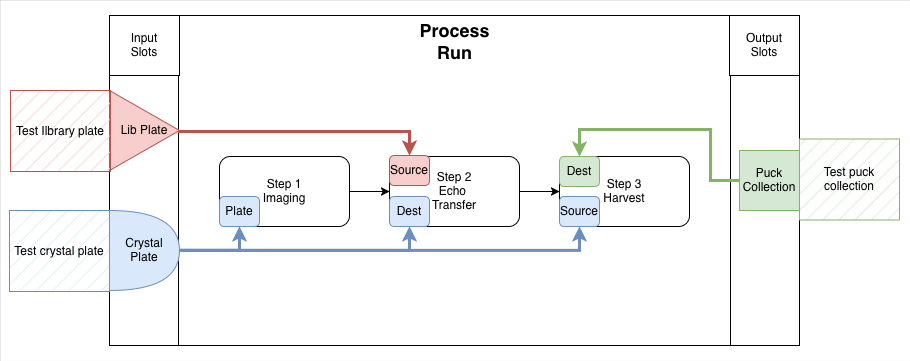
Slots are the joint
A slot is the part worth pausing on, because it is what makes a workflow reusable.
A ProcessTemplate never names a specific plate. Instead it declares a slot, for example an input slot named sample. Each ProcessRun then assigns a real resource to that slot. One template describing “prepare a sample” can therefore serve ten thousand runs, each pointing at a different sample.
Each slot has a direction, either input or output, which is what lets RECAP tell consumption from production, and so build the provenance chain.
How this becomes provenance
Once runs are assigning real resources to slots, the graph builds itself. A run records the resources it consumed and produced, so the outputs of one run are the inputs of the next:
flowchart LR
    SampleA[Sample A]
    Prepare([Prepare Sample])
    Prepared[Prepared Sample A]
    Collect([Data Collection])
    Raw[Raw Data File]

    SampleA -->|input| Prepare
    Prepare -->|output| Prepared
    Prepared -->|input| Collect
    Collect -->|output| Raw
Rectangles are resources and rounded boxes are process runs, so the two alternate along the chain. Reading it as text: Sample A is an input to Prepare Sample, which outputs Prepared Sample A; that is in turn an input to Data Collection, which outputs Raw Data File.
Tracing a result back to its origin means walking that graph backwards. That is what RECAP is for, and it is why the input/output direction on every slot matters.
Next: create and store your first record.
For the deeper treatment of namespaces, hierarchies, and the graph model, see How RECAP Organizes Data.